Gateway Streets

Transportation issues in the Gateway City

A San Francisco Fantasy Map

San Francisco Fantasy Transit Map
Click on image to view the complete map.

Often times my thoughts turn to other cities. This fantasy map for rail-based transit in San Francisco is the culmination of some of those thoughts.

Introduction / Mission Bay Station

The premise behind this map is that the Transbay Terminal need not be the San Francisco terminal station for the upcoming California high-speed rail system and that the existing 4th & King station site, with some modifications, is more than adequate to serve the task. The only service that truly needs to directly serve downtown is Caltrain, details of which are described in its section below. The 4th & King station has been renamed Mission Bay Station to acknowledge it’s increased prominence as a transportation hub.

Yes, I am aware that terminating high-speed rail at Mission Bay Station is illegal according to Proposition 1A and that construction and engineering on the new Transbay Center is likely too far along to change course, but let’s not let that get in the way of a little hypothetical fun. On with the proposals (BRT and infill stations not included).

High-speed rail

CAHSR

High-speed rail follows the Caltrain right-of-way to Mission Bay Station where it would terminate underground on the King St side of the station. This would allow for future development above the station and a later extension of the high-speed rail line underneath King St into a new transbay tube to Oakland and beyond.

Caltrain

Caltrain

Caltrain currently terminates at 4th & King over a mile from the heart of downtown San Francisco. A 1.3 mile tunnel currently in the works will extend Caltrain (and future high-speed rail service) from 4th & King to the new Transbay Center and should be a boon to thousands of Peninsula commuters. However, I don’t think the project is ambitious enough: with a little rerouting, Caltrain could be extended to the Presidio and possibly into Marin County.

From Mission Bay Station, née 4th & King, the Caltrain line extends east underneath Townsend St. The line then curves underneath Essex St (or First St) to a station perpendicular to the Transbay Center with connecting passageways to the Market St tunnel for passengers transferring to BART or MUNI. Proceeding northwards across Market St, the line follows Samsome St (or Battery St) with a station serving the northern end of the financial district at Washington St. Curving underneath Telegraph Hill to Lombard St, the line continues westward with stations at Columbus Ave, Van Ness, and Fillmore before terminating in the Presidio. The Presidio terminus would be designed to allow for a future northward extension across the Golden Gate into Marin County where it could conceivably link up with SMART.

BART

BART

Geary/19th Ave

Dreams of a second transbay tube have been envisioned since before the first one was completed. Likewise, the need for rapid transit along Geary Blvd, of any kind, has long been apparent.

From Oakland, a new BART line shares a new transbay tube with high-speed rail. Just before reaching San Francisco, BART separates from the high-speed rail line to follow underneath Brannon St given that King St and Townsend St already have tunnels for high-speed rail and Caltrain, respectively. The first San Francisco stop at 2nd St would serve the ballpark area; the next stop, 4th St, would serve Mission Bay Station via a connecting passageway. Turning north on 7th St, a station at Folsom St is quickly followed by an interchange with the Market St tunnel at Civic Center. From there, the line finds its way to Geary Blvd with stations at Van Ness, Fillmore, Masonic, Arguello, and Park Presidio. The line then curves southwards via 19th Ave with stops at Judah, Taraval, and Holloway before merging with the existing BART line at Daly City.

Pacifica

Okay, I’ll admit it. Adding a new branch line from Daly City to Pacifica is pure fantasy. But with so many trains converging on Daly City and forced to terminate, why not create a new line to serve an underserved market?

The Daly City station would get a 4th track to allow cross platform transfers between the two trunk lines. From Daly City, the Pacifica line quickly turns west underneath Lake Merced Golf Club and Southgate Ave to a station serving Westlake Shopping Center. The line then curves underneath Skyline Blvd climbing up to a station at Westmoor Ave. Continuing south into Pacifica, the line then surfaces in the median of CA-1 with the final two stations serving the Pacific Manor and Sharp Park neighborhoods.

MUNI

MUNI

Central Subway to Fisherman’s Wharf

The Central Subway’s illogical stub-end in Chinatown is extended to Fisherman’s Wharf via Columbus Ave. A Lombard St station would intersect with the underground Caltrain line proposed above.

Historic Streetcar Extension to the Presidio

As already studied, the historic streetcar F-line would extend from Fisherman’s Wharf to the Presidio via the Fort Mason tunnel and Marina Blvd. Within the Presidio, I’ve shown the P-4 option from the 2004 feasibility study which would take the streetcar on a one-way loop via Mason, Halleck, Lincoln, and Girard. A station at the intersection of Lincoln and Girard would serve the Caltrain terminus station proposed above.

Extension of N-Line from Mission Bay Station via Division and Duboce

Going west from the E-Embarcadero on King St, streetcars would turn right on a 4th or 5th St and then left on Townsend St. Streetcars would then proceed along Division, 13th, and Duboce to reach Market St. At Market St, I can’t decide whether the line should be on the the surface, underground, or both to maximize operational flexibility.

Geneva Connection

The T-Third is extended west from its southern terminus to Balboa Park via Geneva Ave forming yet another large loop in the MUNI streetcar system.

Credit

Credit goes to Transbay Blog from which many of the ideas and inspiration for this fantasy map of mine came.

Illinois May Receive More Money for High-Speed Rail

According to the Wall Street Journal and New York Times, the White House is going to redirect high-speed rail money previously allocated to Wisconsin and Ohio to other states including Illinois.

Congressional sources say the Obama administration is taking $1.2 billion in high-speed rail money away from Ohio and Wisconsin and awarding it to projects in other states.

People familiar with the grants say the Department of Transportation will announce Thursday that California, Illinois and New York, among other states, will get a share of the funds.

Republican governors were recently elected in Wisconsin and Ohio and both have pledged to stop their high-speed rail projects. Illinois was previously awarded $1.1 billion back in January to increase speeds on the Chicago to St. Louis corridor to 110 mph.

The lion’s share of the money will go to California and Florida, the only two states with true high-speed rail programs. Illinois is set to receive an additional $42.3 million. Missouri will, also, receive an amount less than $10 million.

Update: Missouri will receive up to $2.2 million. (US Deparment of Transporation)

"South County Connector" Open House

#alttext#
River Des Peres Pkwy may be extended northwards from Lansdowne Ave to Hanley Rd. // St. Louis County Arterial Study – South Study Area.

St. Louis County is hosting an open house on December 9 where it will present information about its proposed “South County Connector.” The meeting begins at 3 p.m. and will conclude at 7 p.m. in the Affton White-Rodgers Community Center located at 9801 MacKenzie Road.

Though details about the “South County Connector” are lacking on the open house announcement page, the project likely involves a northwards extension of River Des Peres Pkwy to Big Bend Blvd or Hanley Rd. An alignment option from the 2005 study is shown above.

The intent of an extended Des Peres Pkwy is to improve connectivity between mid and south St. Louis County. The county has been looking for ways to fix this “missing link” ever since the cancellation of the southward extension of I-170 to I-44 and I-55 in the 1990s. The Cross County MetroLink extension and the deferred Metro South extension were projects meant to supplement the cancelled I-170 highway project.

In a related project to facilitate increased vehicular traffic between mid and south St. Louis County, the county is widening Hanley Rd to six lanes from I-64 south to Flora Ave. Part of this project involves reconfiguring the intersection of Hanley and Manchester as a median u-turn intersection. Prior to early 2009, the county had considered building a SPUI interchange at this location, but changed plans for a variety of (good) reasons.

Update: The “South County Connector” project website is now up and running.

1 response

Speeding Through Downtown at 35 MPH

#alttext#
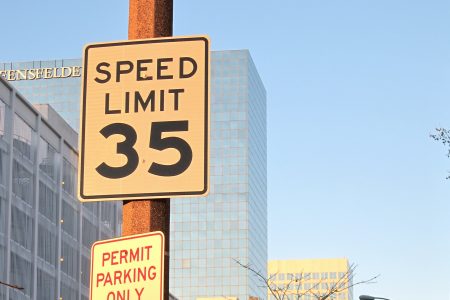
4th St. at Spruce St.

The speed limit on the majority of streets in the St. Louis CBD is 25 mph. Outside the CBD, but still within downtown, speed limits are commonly set at 30 mph. Some of the arterial roads through downtown, however, have 35 mph speed limits despite crossing major pedestrian corridors. Pedestrian safety, it seems, plays second fiddle to making sure vehicles get from one side of downtown to the other as quickly as possible.

More and more cities have begun promoting 20 mph speed limits to improve pedestrian safety, and for good reason. According to the UK Department for Transport, if a driver hits a pedestrian at 30 miles per hour, the victim only has a 55 percent chance of surviving. At 20 mph, the pedestrian has a 95 percent chance of survival.

The following streets downtown are signed at 35 mph:

  • Memorial Drive
  • 4th St south of Market St
  • Tucker
  • 14th St
  • Market St west of Tucker
  • Olive St west of Tucker

Tucker and 14th St both cross Washington Ave, downtown St. Louis’ premiere street and busiest pedestrian corridor. On the southern end of downtown, 14th St also passes the Civic Center transit hub where MetroLink and MetroBus riders frequently cross the street to access jobs, connecting buses, and events at Scottrade Center.

But perhaps most baffling of all are Memorial Drive and 4th St. Thousands of tourists cross these two streets every year to access the Arch and Old Courthouse. Improved sidewalks to cross Memorial Drive and the I-70 trench were only just completed last year. Yet, the speed and volume of traffic on these streets still scream danger. The 35 mph speed limits on these streets are unacceptable.

For comparison purposes, the 3-5 lane streets on either side of Fort Washington Way in downtown Cincinnati—very similar to I-70 and Memorial Drive, here—have 25 mph speed limits.

Amazingly, the long highway ramp connecting Pine St. to I-64 has a lower speed limit (30 mph) than any of the downtown St. Louis streets listed above.

Fountain Park Bike Lane in the Door Zone

Fountain Park Bike Lane
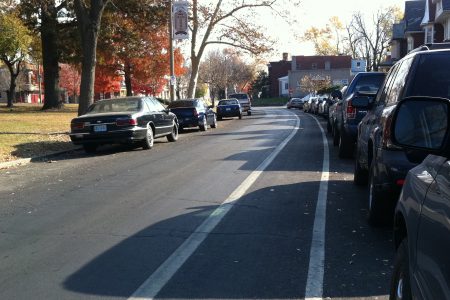
Bike lane on Fountain Ave

Streetsblog San Francisco recently posted an excellent article titled “Why Are We Building Bikes Lanes That Are Hurting People?” The premise of the article is that many bike lanes are marked too closely to rows of parked cars putting cyclists in danger of getting “doored.”

Over the past 2 years, I’ve ridden my bike on most of the on-street bike lanes in St. Louis. I usually seek out bike lanes whenever I’m out biking as I find them more comfortable and less stressful to ride in being outside the normal flow of traffic.

The bike lanes surrounding Fountain Park, however, I will never ride in again. The one time I attempted riding in the bike lane, it felt very uncomfortable, dangerous even. The row of parked SUVs were so close to the bike lane that I was incredibly nervous about getting doored. And with cars parked on the left side of the street, as well, the road felt too narrow to ride on the left side of the bike lane while leaving space for cars to pass me.

The next time I ride my bike through Fountain Park, I will ride in the middle of the traffic lane, instead.

1 response

MoDOT Trying to Squeeze More Capacity Onto I-64, Too

D5093_CM-2
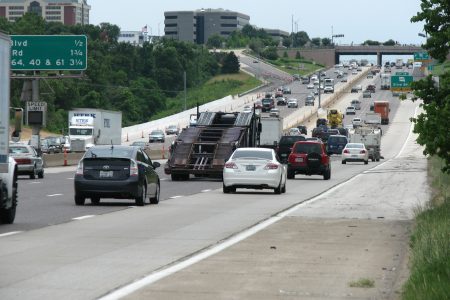
I-64 west of I-270. // MoDOT Photos.

MoDOT has ambitions to add capacity to I-64 between I-270 and MO-141, if its recent failed TIGER grant application is anything to go by.

Much like its planned project on I-270 between I-44 and Manchester Rd, MoDOT plans to add capacity to I-64 between I-270 and MO-141 by restriping the existing pavement to squeeze in an additional lane in each direction. Reconfiguration of some ramps will be necessary, as well.

According to MoDOT, “we are still working on the traffic study and model, so we really don’t have any plans for that project yet.” The project is estimated to cost $17 million. Funding for the project has not yet been secured.

MoDOT to Squeeze Additional Capacity Onto I-270

I-270
Vehicles coming from I-44 merge onto northbound I-270.

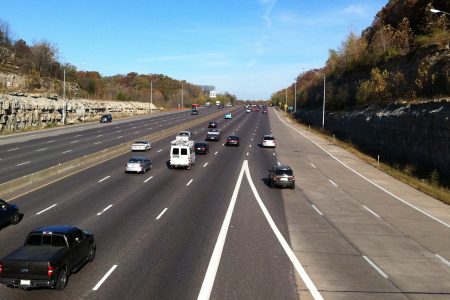
Come 2012, commuting on I-270 between I-44 and Manchester Rd will become a little easier and faster. MoDOT is planning on adding an additional lane in each direction to portions of the route, reducing travel times by up to two minutes.

The 4 mile stretch of Interstate 270 between Manchester Rd and I-44 is one of the most congested segments of highway in the St. Louis region. Everyday, 150,000 vehicles travel along this section of highway which during the AM and PM peaks has a level of service rating of F and average speeds of 32 mph. The additional lane capacity should improve the LOS to D and increase average speeds to 60 mph.

#alttext#
One option would add 1 lane in each direction from north of I-44 to south of Dougherty Ferry Rd. // MoDOT.

In order to squeeze an additional lane on both sides of the highway, MoDOT will narrow the lanes on I-270 to 11-ft and reduce the width of the inside and outside shoulders. The tightest points will be underneath the Union Pacific and BNSF railroad bridges where the existing bridge support columns will reduce the shoulder to as little as 1-ft wide.

The changes will be very similar to the ones used on I-44 and I-70 during the recent shutdown of I-64. In order to accommodate the increased travel demand on I-70 and I-44, MoDOT narrowed the existing lanes and shoulders in order to squeeze an additional lane in each direction.

MoDOT is using its recent experiments with lane narrowing on I-70 and I-44 to justify its project on I-270. In particular, MoDOT says that the narrow lanes and shoulders on I-44 had no net impact on highway safety.

Two options for lane additions on I-270 are still under consideration. The first option would add lanes from north of I-44 to south of Dougherty Ferry Rd. The second option would extend the northbound lane in option 1 to Manchester Rd resulting in six northbound lanes on I-270 between Dougherty Ferry Rd and Manchester Rd.

The project is expected to cost a bargain-basement $3.8 – $5 million. Other related works push the project total up to $11 million as currently allocated in the latest Transportation Improvement Program. MoDOT and East-West Gateway previously applied for federal assistance through the TIGER grant program, but the bid failed. MoDOT estimates that a similar project on I-270 using standard width lanes and shoulders would cost in excess of $150 million.

Exhibits showing some of the project impacts can be seen by clicking here.

Let Bikes Through

DSC00625
Pershing Ave dead-ends just west of De Baliviere Ave.

Biking is relatively easy across most of the City of St. Louis. The street grid makes it easy to get around and easy to find a street with light vehicular traffic… most of the time. Other times, biking within the city can a frustrating affair when one comes upon one of the 262 points where the street grid has been severed.

Many of the 262 street closures within the City of St. Louis were done with the benign purpose of reducing vehicular traffic on residential streets. Many of them, also, had a not so hidden subtext to shield wealthy neighborhoods from nearby crime and urban decay.

Street closures within the city are generally set in three common variations. The most elaborate street closures include small gardens and decorative fencing within the former street space. Slightly simpler, some closures simply convert the streets into two large bulbs separated by five feet of grass and concrete. The most basic street closures are performed by simply placing a series of large concrete planters, often made out of ugly concrete sewer pipes, within the street right-of-way.

Makeshift curb ramp
A crude asphalt ramp allows bicyclists to reach the sidewalk on Laclede Ave just east of Taylor Ave.

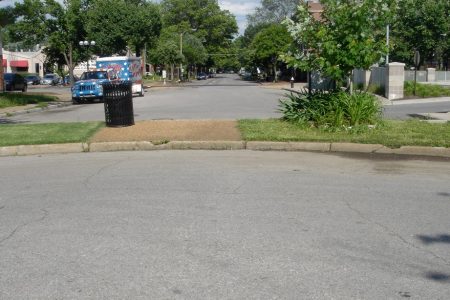
Of the three common variations of street closures, only the ones with concrete planters generally allow cyclists to go through without using the sidewalk. The other types of closures almost always lack any sort of cut-through passageway for bikers or even a ramp to access the sidewalk. If ramps are found, they are often crudely built, such as the one pictured on the left.

Anyways, to avoid rambling any further, most streets within the City of St. Louis have been closed for one of two reasons: to reduce or hinder vehicular traffic or to ward off crime. These barriers, however, were not erected to keep bicyclists off of neighborhood streets, though that is their effect. Bicyclists will not harm the quality of life these street barriers were erected to protect. Also, bicyclists should not have to zig-zag across city streets to find a continuous route.

Proposal

All new street closures must include accommodations for pedestrians and bicyclists to get through, where possible and reasonable. For an example, please see this short film from Streetfilms about Portland’s use of “diagonal diverters” that keep streets free of vehicular through traffic but allow bikes to get through.

St. Louis Bike Plan Open House

Today and tomorrow, Great Rivers Greenway is hosting open houses for the St. Louis regional bike plan. Please attend or sumbit comments if you wish to help shape the future of cycling in the St. Louis area.

Wednesday, October 13th, 2010
4:30 to 7:00 pm
Maryland Heights Community Centre
2344 McKelvey Road
Maryland Heights, MO 63043
Thursday, October 14th, 2010
4:30 to 7:00 pm
The Heights, Richmond Heights
8001 Dale Avenue
Richmond Heights, MO 63117

Does Laclede's Landing or the Arch Need Washington Avenue?

MVVA, the winning design team in the Arch grounds competition, proposes closing Washington Avenue from Memorial Drive to the Mississippi River. The competition jury, on the other hand, had very strong feelings towards keeping the road in place. Washington Ave currently serves as one of the primary means of accessing Laclede’s Landing and the Arch parking garage. But is it actually needed?

It’s a Mistake

archview_0317
Laclede’s Landing. // MBK (Marjie).

Washington Ave lies on the border between Laclede’s Landing and the Arch grounds and is one of the principal gateways into both destinations. For the Arch, the memorial’s 1024 space parking garage lies on Washington Ave; for Laclede’s Landing, Washington Ave is one of the few roads into the area. The Arch parking garage also serves many of the workers and patrons of Laclede’s Landing.

Given the reasons above, it should not be surprising that the opinions expressed in the competition summary report were generally against the idea of closing Washington Ave. What is surprising is how strong those opinions were.

The report made multiple mentions of MVVA’s proposed closure of Washington Ave. According to the technical advisory group:

There are serious concerns with the elimination of Washington Street and the probable routing of traffic through Laclede’s Landing.

The jury report was even more blunt. In the section regarding the mitigation of impacts of transportation systems, the jury report said:

Closure of Washington Ave from Memorial Drive to the river is a mistake. The reasoning for that recommendation is not clear.

With or Without, Mitigation Needed

Without Washington Ave, there’s no question that vehicular access to Laclede’s Landing and the north side of the Arch grounds would be reduced. Changes to the streets of Laclede’s Landing would have to be made to accommodate different traffic patterns. On the other hand, the pedestrian environment would improve greatly with the melding of the Arch grounds with the Landing and a significantly simplified intersection at Memorial Drive and the Eads Bridge.

With Washington Ave in place, vehicles would be able to continue to access the Arch parking garage without going through the Landing. And since the parking garage will be replaced with an underground version, accessing the Arch grounds from Laclede’s Landing should become a rather simple and pleasant experience, an enormous improvement from the current connection through the existing parking garage.

In the end, Washington Ave can probably be removed without too much harm. But either way, connections from Laclede’s Landing to downtown should be restored to lessen the impact to the Landing’s streets and reduce its isolation: Lucas, for example, should be restored to 3rd St and Morgan St should be connected to 4th St. It will be interesting to see what changes MVVA makes at the competition sponsor’s request.

Memorial Drive Parking Garage

Parking was a major concern of many of the design teams in the Arch grounds design competition. For example, from the narrative of the MVVA team’s winning proposal:

Our proposal instead harnesses the power of parking, and spreads it over the entire edge of the site, creating permeable thresholds and activity bridges to the north, south, and west of the Arch grounds.

Every single design team that proposed new parking garages placed a garage underneath Luther Ely Smith Park, the MVVA team included. The parking garage proposed by the MVVA team could have 280 parking spaces on two underground levels. But what if there is the opportunity for something bigger?

#alttext#

City to River would like to replace I-70 and Memorial Drive with an urban boulevard, an idea acknowledged by all five design teams in the Arch grounds design competition. But before I-70 is filled in post-2015, perhaps something can be done with the void the highway created. Something such as a large underground parking garage.

Roughly 2400 feet separate Locust St from Spruce St. If the parking garage is 120 ft wide with 2 parallel rows of parking and the average parking space requires 330 sq-ft, then a parking garage underneath Memorial Drive would have a capacity of about 2,050 spaces on 2 underground levels including the area underneath Luther Ely Smith Park. And by taking over the space occupied by I-70, much of the digging has already been done.

This proposed parking garage would be almost twice as large as the existing garage on the Arch grounds. It would provide convenient parking for not just visitors to the Arch, but for workers, guests, and residents of the buildings along Memorial Drive.

Another reason to build such a large parking garage underneath Memorial Drive would be to diminish the importance of the Stadium East garage. The Stadium East and Stadium West garages have a combined 5,100 spaces on either side of Busch Stadium. They also occupy valuable property in the middle of downtown and bookend the future Ballpark Village site. The Stadium East garage, in particular, with it fantastic potential views into Busch Stadium, should come down and become an extension of Ballpark Village.

Then again, if a new parking garage underneath Memorial Drive does not replace any other parking downtown, then it would simply add to the already gross oversupply of parking that downtown has.