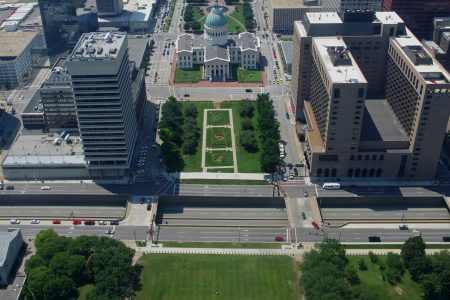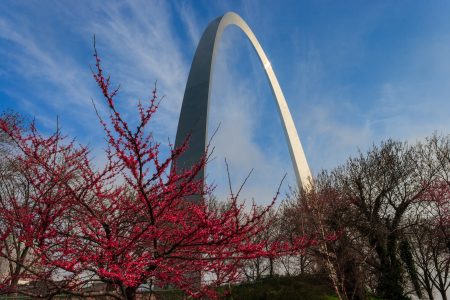
[Bob Moore] also recounted that the berms were not originally part of the design, but were added and executed as part of the design in 1957-1961. The berm height was later raised by NPS in order to help with traffic noise.
ULI Presents Bold Ideas for Area Around Grand Station
Chouteau’s Greenway, a high speed rail hub at the Grand MetroLink Station and/or a platform development were all bold ideas presented by the local Urban Land Institute (ULI) Panel of experts as transformative measures for the area around the Grand MetroLink Station as a part of a study commissioned by CMT.
Couldn’t make it to the meeting? Citizens for Modern Transit has a summary of the event and a link to the presentation.
Developing The North Hanley MetroLink Station
Steve Patterson of Urban Review STL gives his thoughts on the North Hanley MetroLink station, surroundings, and development potential after attending Citizens for Modern Transit’s walkabout tour of the station. Unfortunately, it seems that the tour did not make it to Hanley Rd side of the station where the pedestrian accommodations are less than ideal even after recent improvements. More on that later.
Boulevard This!
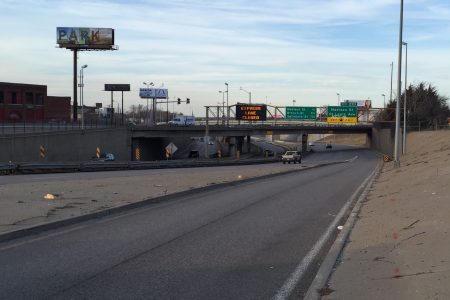
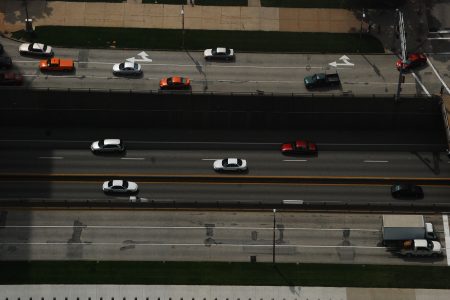
MoDOT recently released the draft environmental assessment report for the Park over the Highway project, one of the major elements of the Arch grounds renovation project led by CityArchRiver 2015, and is now soliciting public comments on the document. As proposed, the PotH project will build a one-block “lid” over the depressed lanes of I-70, close at least one block of Memorial Dr, remove the Pine St bridge over the highway, and make many other changes to highway infrastructure.
A public hearing will be held on August 29, 4-7 p.m. at 1520 Market Street. Comments may be submitted at the public hearing, mailed to MoDOT/CR, or submitted on-line by using this form.
MoDOT will provide a virtual public hearing website to display the information shared at the public hearing. That website will be launched on August 29.
River City Casino Not Connected to Nearby Trail
Much like many sidewalks in the region, what is the purpose of trails if they don’t provide connections to nearby destinations?
The Mississippi River Greenway passes and parallels within 16ft of the roads surrounding River City Casino. Yet, despite getting so close, not a single connection exists between the casino roads and the “adjacent” trail much less the casino itself. A hike through the grass is required to reach the trail.
For a while, this 1/2 mile section of trail was an isolated segment that did not connect anywhere to anywhere. Recently, a one mile extension of the trail was built that connected the River City Casino segment to the Jefferson Barracks system of trails (this new segment, by the way, is one of the most breathtaking and beautiful trails of anywhere in the St. Louis region). Great Rivers Greenway is, also, actively planning a much larger extension to the north to complete the Mississippi River Greenway all the way to the Gateway Arch.
But there are still no plans to provide a connection from River City Casino to the nearby trail.
Pedestrian Countdown Timers That Lie
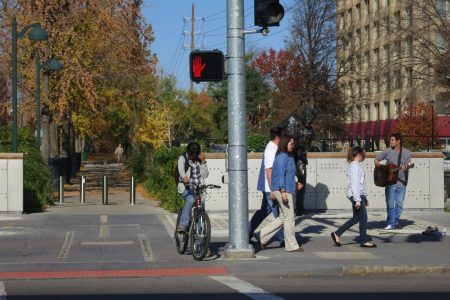
If you are attempting to cross Lindell at Euclid and you see that the pedestrian signal is showing a solid red hand, chances are you can still safely cross the road. That is because the pedestrian countdown timer lies, reaching zero a full 15 seconds before the traffic light turns yellow.
Because the countdown timers at this intersection are so far out of sync with the traffic lights, I now completely ignore the pedestrian signals. I have seen other people ignoring the pedestrian signals and have even told people who stopped that they can safely proceed. What’s the purpose of having countdown timers if they are wildly inaccurate and ignored by the pedestrians they are meant to inform and protect?
The pedestrian countdown timers at this intersection are hardly the only ones I’ve seen that mislead pedestrians trying to cross the road. Long ago, I reported an issue with the countdown timers crossing DeBaliviere at Lindell in front of the Missouri History Museum; the intersection of Skinker and Forest Park has been a long standing issue; and countdown timers throughout downtown Clayton shortchange pedestrians by 6 seconds before the traffic lights turn yellow.
After reporting the problem with the countdown timers on Euclid at Lindell to the St. Louis CSB last month, the Traffic and Lighting division “supposedly” adjusted the timing of the signals. Supposedly is in quotes because, as of today, the pedestrian countdown timers still lie by the same 15 seconds as they did before.
Public Meeting Wednesday
A number of public meetings and open houses on various transportation topics will be held on Wednesday, June 20.
Great Rivers Greenway will be hosting an open house to present plans and accept comments for an 8-mile trail extending from Downtown St. Louis to the River des Peres.
Mississippi River Greenway: Downtown to the River des Peres
YMCA Recreational Complex in Carondelet Park
930 Holly Hills Dr
4:00 – 7:00 p.m.Every year, East-West Gateway presents its report on how it plans to spend the St. Louis region’s transportation dollars for the next four years. This meeting is the last one being held in Missouri. Comments will be accepted until July 6.
Transportation Improvement Program for FY 2013-2016
Maryland Heights Government Center
11911 Dorsett Rd
4:00 – 7:00 p.m.University City is, once again, giving its residents (or anybody else) an opportunity to learn about and comment on the Loop Trolley project slated to begin construction by January 2013.
Loop Trolley Public Meeting
University City Library
6701 Delmar Blvd, 2nd floor auditorium
6:30 – 9:30 p.m.
Top 25 Rail-Based Transit Systems in the United States
Good statistics: #STL has 10th busiest (REAL) light rail system in nation, in 18th largest metro area. We should all be proud as hell.
— The Count (@countondowntown) June 6, 2012
Now I’m a believer in St. Louis’s MetroLink as an efficient and effective light-rail transit system, but I also understand that it has its limitations. Which is why I’m calling out The Count’s statistic as misleading.
Count On Downtown’s light-rail statistic comes from this Wikipedia article which is based on data from the APTA. Per the article, MetroLink is in fact the 10th busiest light-rail system in the country. As recently as 2008, MetroLink was ranked 7th (Dallas, Denver, and Salt Lake City have since surpassed St. Louis).
But just because they don’t have light-rail systems doesn’t mean that St. Louis is better than New York or DC. To measure only light-rail systems against each other ignores the fact that they often operate as a part of a larger transit network in a metropolitan region. When taking the total of all rail-based transit systems (minus commuter rail) in a metro area, St. Louis ranks 16th only just punching above it’s own weight in terms of population.
And with expansion of the MetroLink system stalled for the foreseeable future (Hello! Missouri legislature!), St. Louis’s ranking will likely fall to 21st in as little as 5 years.
The table below summarizes the top 25 rail-based transit systems excluding commuter rail, but combining totals from separate metropolitan transit agencies (e.g. Philadelphia). Cities marked with a caret symbol will likely eclipse St. Louis in the next 5 years.
| Rank | Metro | Ridership | Population | Pop. Rank |
|---|---|---|---|---|
| 1 | New York | ∞ | 18,897,109 | 1 |
| 2 | Washington D.C. | 979,600 | 5,582,170 | 7 |
| 3 | Boston | 765,400 | 4,552,402 | 10 |
| 4 | Chicago | 709,700 | 9,461,105 | 3 |
| 5 | San Francisco | 567,400 | 4,335,391 | 11 |
| 6 | Philadelphia | 486,000 | 5,965,343 | 6 |
| 7 | Los Angeles | 315,800 | 12,828,837 | 2 |
| 8 | Atlanta | 228,300 | 5,268,860 | 9 |
| 9 | Portland | 125,600 | 2,226,009 | 22 |
| 10 | San Diego | 96,900 | 3,095,313 | 16 |
| 11 | Miami | 96,600 | 5,564,635 | 8 |
| 12 | Baltimore | 78,500 | 2,710,489 | 19 |
| 13 | Dallas | 71,100 | 6,371,773 | 4 |
| 14 | Denver | 70,300 | 2,543,482 | 20 |
| 15 | Salt Lake City | 57,200 | 1,124,197 | 47 |
| 16 | St. Louis | 50,500 | 2,812,896 | 18 |
| 17 ^ | Sacramento | 48,700 | 2,149,127 | 24 |
| 18 ^ | Phoenix | 44,000 | 4,192,887 | 13 |
| 19 ^ | Houston | 37,400 | 5,946,800 | 5 |
| 20 | San Jose | 31,700 | 1,836,911 | 30 |
| 21 | Cleveland | 27,500 | 2,077,240 | 27 |
| 22 ^ | Minneapolis | 27,100 | 3,279,833 | 15 |
| 23 ^ | Seattle | 26,200 | 3,439,809 | 14 |
| 24 | Pittsburgh | 24,100 | 2,356,285 | 21 |
| 25 | Buffalo | 23,200 | 1,135,509 | 48 |
Alternative Concept for I-64 Interchange at Boyle/Tower Grove
The influx of traffic coming from a soon to be built I-64 interchange at Tower Grove will present an additional danger to pedestrians and bicyclists attempting to cross the highway. That’s what many citizens expressed at a recent public meeting to plan for a new MetroLink station at Boyle (presenters too).
North of the highway, CORTEX has big plans. Over the next 20 years, the district will add over 4 million square feet of building space and more than 11,000 jobs. The growing CORTEX district will mean many many more people will want to cross I-64.
The additional traffic the new interchange will dump onto the area’s streets means MoDOT should do whatever is necessary to mitigate dangers and make enhancements to encourage use by pedestrians and bicyclists. Of particular concern was Tower Grove where it intersects with the off-ramp at a roundabout especially since Tower Grove is a designated Bike St. Louis route.
With all that in mind, I would like to propose the following idea: should the eastbound I-64 off-ramp to Tower Grove be relocated east of Boyle? I’ve sketched out my idea below.
Transit-Oriented Crap
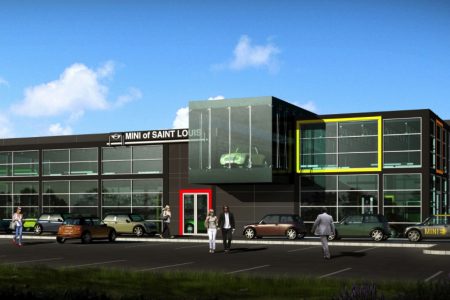
The antithesis of transit-oriented development. That’s what I called the plan for the site adjacent to the Sunnen MetroLink station that is currently under construction, a Mini car dealership surrounded by more than 500 parking spaces.
Then I found this image and description on Cozad Commercial Real Estate’s website which shows the next phase of development.
Sunnen’s goals for Sunnen Station are to establish a master plan that will allow for future growth, development and adaptability to change in our constantly changing real estate market; as well as promote the lifestyle of the development, including access to transit, greenways and an urban mix of uses as a highly desirable place to work.
What a load of crap.
Cross-posted at nextSTL.